
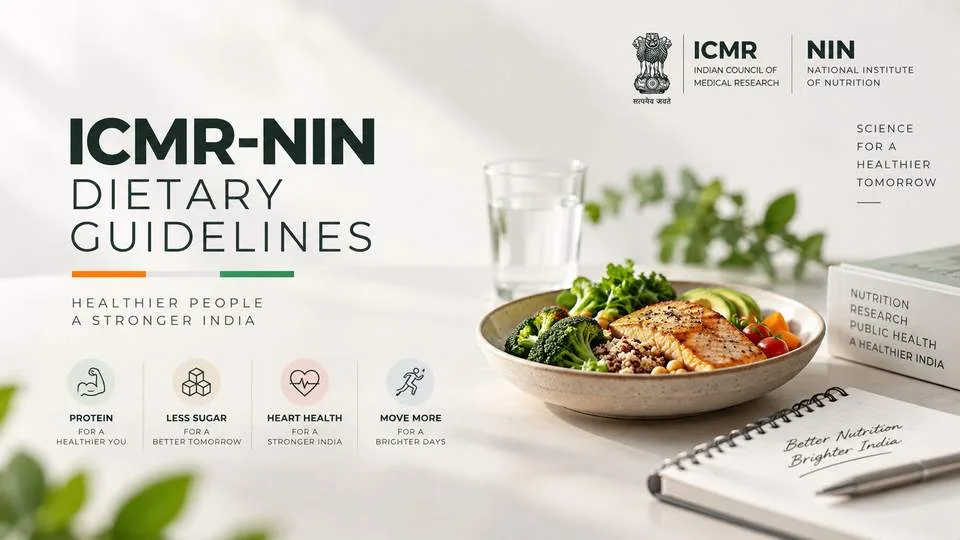
The National Institute of Nutrition (ICMR-NIN), under the Indian Council of Medical Research, has published updated evidence-based dietary guidelines establishing revised daily nutrient recommendations for the Indian population. The clinical consensus report addresses the rising prevalence of cardiometabolic conditions, fatty liver, and type-2 diabetes, delivering clear, quantitative parameters for daily protein consumption, strict thresholds on free sugars, and structured ergonomic movement protocols tailored for sedentary desk workers.
This analytical health science review synthesizes the key clinical findings, evidence grades, and actionable metabolic protocols formulated by the national expert panel.
1. Clinical Macronutrient Parameters: Protein Intake & Quality
The revised consensus clarifies long-debated dietary standards regarding daily protein allowances, emphasizing biological value and complete amino acid profiles:
Recommended Daily Allowance (RDA): 0.83 grams to 1.0 gram of high-quality protein per kilogram of healthy body weight for sedentary and moderately active adults.
Distribution Across Meals: Recommendations advocate distributing 20 to 30 grams of protein evenly across three main meals to optimize muscle protein synthesis (MPS) rather than consuming protein in a single bolus.
Bioavailability & Complementarity: For plant-based diets, the guidelines emphasize combining cereals with pulses in a 3:1 or 4:1 ratio to overcome essential amino acid deficiencies (specifically lysine and methionine).
Whole-Food Prioritization: Focus on whole dietary sources—eggs, paneer, curd, lentils, chickpeas, soy, and lean fish—over highly processed protein powders containing artificial emulsifiers.
2. Carbohydrate Quality & Strict Added Sugar Caps
To combat widespread visceral adiposity and insulin resistance, the panel established definitive quantitative caps on simple carbohydrates and ultra-processed foods:
Free Sugar Threshold: Added free sugars must not exceed 5% of total daily caloric intake (approximately 20 to 25 grams per day for an average 2,000 kcal intake).
Dietary Fiber Minimums: Daily dietary fiber intake must exceed 30 grams per 2,000 kcal, prioritizing complex carbohydrates with low glycemic indices (whole millets, oats, legumes, and unrefined grains).
Trans-Fat Zero Tolerance: Strict elimination of partially hydrogenated oils and industrial trans-fats, capping total saturated fat intake below 7% of daily calories.
3. Desk Worker Metabolic Ergonomics: The 20-8-2 Movement Protocol
Prolonged uninterrupted sitting induces acute metabolic dysfunction, including reduced lipoprotein lipase activity and impaired postprandial glucose clearance. The guidelines integrate occupational ergonomics recommendations:
The 20-8-2 Rhythm: For every 30-minute working block, desk workers should maintain 20 minutes of seated posture, 8 minutes of standing work, and 2 minutes of active movement or gentle walking.
Post-Meal Ambulation: A brisk 10 to 15-minute walk within 30 minutes following major meals significantly attenuates postprandial glucose excursions.
Hydration Standards: Base daily fluid intake of 30 to 35 ml per kilogram of body weight to maintain optimal renal filtration and cognitive focus during prolonged screen time.
Frequently Asked Questions (FAQ)
What daily protein intake does ICMR-NIN recommend for adults?
The clinical guidelines recommend 0.83 to 1.0 gram of protein per kilogram of healthy body weight per day from diverse, bioavailable whole-food sources.
What is the recommended upper limit for daily added sugar?
Added free sugars should be strictly capped below 5% of total daily energy intake, which corresponds to approximately 20 to 25 grams (about 4 to 5 teaspoons) per day.
How does the 20-8-2 ergonomic protocol combat sedentary lifestyle risks?
The protocol alternates 20 minutes of sitting with 8 minutes of standing and 2 minutes of active movement, reactivating cellular enzymes like lipoprotein lipase to optimize glucose and fat metabolism.
Health Information Notice: Published for public educational and scientific communication based on official guidelines from the Indian Council of Medical Research - National Institute of Nutrition (ICMR-NIN). This content does not constitute personal medical diagnosis or individualized healthcare prescription.